
Seals are the "small parts, big cores" of various hydraulic, pneumatic, and transmission equipment. Although they may seem insignificant, they directly determine whether the equipment will leak oil, gas, or dust, and whether it can operate stably under pressure. Its core function is simple: to block the oil, water, and gas inside the equipment, to block the dust, impurities, and water vapor outside, to protect the internal structure of the equipment, and to reduce wear and failure.
Many people mistakenly believe that equipment sealing failures and component damage are caused by long-term aging of materials, but in fact, industry data shows that:More than 80% of seal failures are caused by human factors such as incorrect selection and non-standard installationIn order to help everyone quickly understand, use correctly, and install seals, this article uses simple and straightforward language to comprehensively explain the functional classification, material differences, applicable scenarios, and installation points of seals, making it easy to understand even with zero foundation.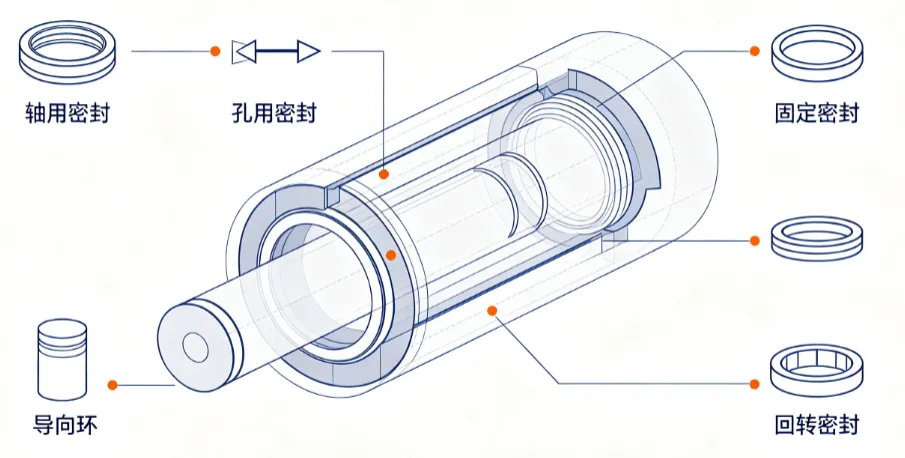
1、 Classified by function: 6 types of seals, each with its own responsibilities and cannot be mixed
According to their usage location and working mode, seals are mainly divided into 6 categories, each with a different purpose and working state, and cannot be interchanged.
1. Shaft seal (piston rod seal)
AdaptationAxis moving, body stationaryThe telescopic scene is mainly installed at the position of the oil cylinder and cylinder head, with the sealing ring tightly fitted onto the piston rod. During work, it follows the reciprocating expansion and contraction of the piston rod, with the core function of blocking the oil in the cylinder and preventing it from leaking out along the piston rod.
Common types include Y-rings, U-rings, and seals, which are commonly used for piston rods in various hydraulic and pneumatic equipment. They are suitable for medium to high pressure and frequent expansion and contraction conditions, and have high requirements for wear resistance and compression resistance.
2. Hole sealing (piston sealing)
Opposite to shaft sealing, it is compatiblePiston moving, shaft not movingIn the scene, the seal is installed on the piston, and the outer ring is tightly attached to the inner wall of the oil cylinder. Its function is to separate the two oil chambers before and after the oil cylinder, ensuring that the equipment can be pressurized and work normally. It is the core sealing component for the power output of the oil cylinder.
The commonly used Y-rings and grid rings with holes have completely different sizes and assembly methods from shaft seals, and are strictly prohibited from being mixed. They are mainly used on various hydraulic cylinder pistons.
3. Dust seal (dust ring)
Belonging to auxiliary protective accessories,Cannot withstand pressure, nor prevent oil leakageOnly responsible for 'cleaning'. It is installed at the outlet of the piston rod on the outermost side of the oil cylinder. When the piston rod extends and retracts, the dust ring will scrape off the soil, dust, and water droplets on the surface of the rod, avoiding impurities from being brought into the oil cylinder and causing wear on the cylinder wall and main seal.
Dust seals must be used in conjunction with main seals and are widely used in hydraulic equipment for outdoor work such as excavators and construction machinery.
4. Guiding ring (support ring)
There is no sealing function at all, only responsible for "supporting and aligning". When the equipment is working, the piston and piston rod are prone to force displacement. The guide ring can withstand lateral pressure, avoiding direct friction and collision of metal parts, preventing the cylinder body and piston rod from being scratched, and ensuring that the parts move coaxially and do not deviate.
All high-pressure and heavy-duty hydraulic cylinders are equipped with guide rings, which are key components for protecting equipment and reducing wear.
5. Fixed seal (static seal)
used inNot moving at allThe fitting position of the equipment, such as flanges, end caps, pipe joints, and cylinder head joints. By relying on the compression deformation of seals, the gaps between parts are filled to achieve sealing.
Because there is no motion friction, this type of seal does not require wear resistance, and the focus is on rebound ability and medium resistance. Common sealing accessories for industrial equipment include O-rings and rubber gaskets.
6. Rotary seal (rotary oil seal)
Specially used forA continuously rotating shaftUp, it is completely different from the reciprocating expansion seal. When the shaft rotates at high speed, heat is generated, so this type of seal requires low friction and high temperature resistance, mainly to prevent oil leakage and ash ingress at the rotating shaft position.
The most typical product is the skeleton oil seal, which is commonly used in rotating equipment such as hydraulic motors, gear pumps, and motor shafts.
2、 Classified by material: 8 commonly used materials to distinguish, choose without stepping on pitfalls
The durability and adaptability of seals are entirely determined by the material, and different materials have significant differences in temperature resistance, oil resistance, corrosion resistance, and wear resistance. Choosing the right material is more important than choosing the right model.
1. Nitrile rubber (NBR) - a universal cost-effective option
The most common and cost-effective sealing material on the market, with good oil and hydraulic oil resistance, wear resistance, and good rebound, suitable for temperatures ranging from -30 ℃ to 120 ℃. The disadvantage is that it is not resistant to high temperature steam, strong acid and alkali.
Suitable for the vast majority of room temperature hydraulic equipment and ordinary machinery, O-rings and Y-rings are the preferred materials for conventional hydraulic working conditions.
2. Ethylene propylene diene monomer (EPDM) - waterproof and heat-resistant special product
The core advantages are water resistance, hot water resistance, steam resistance, aging resistance, not afraid of weak acids and bases, suitable for temperatures ranging from -40 ℃ to 150 ℃.Biggest taboo: afraid of engine oil and hydraulic oilContact with oil can cause rapid expansion and damage.
Only used for oil-free conditions such as water treatment equipment, steam pipelines, drinking water equipment, and civilian valves.
3. Fluororubber (FKM) - High temperature anti-corrosion high-end model
High end special materials, resistant to oil, fuel, and various chemical corrosive media, with strong high temperature resistance, suitable for temperatures ranging from -20 ℃ to 200 ℃. The only drawback is that the low-temperature elasticity is average and the price is expensive.
Specially used in harsh working conditions such as high temperature, oil pollution, and chemical corrosion, such as high-temperature hydraulic equipment, internal combustion engines, and chemical equipment.
4. Silicone (MVQ) - Low temperature and high temperature universal static sealing product
The temperature resistance range is extremely wide (-60 ℃~220 ℃), environmentally friendly, non-toxic, anti-aging, suitable for high and low temperature environments. But the material is soft, not wear-resistant, and afraid of engine oil, so it cannot be used in positions where there is friction during movement.
Only used in low-pressure, static sealing scenarios such as food equipment and high-temperature ovens, and strictly prohibited for use in hydraulic moving parts.
5. Fluorosilicone rubber (FVMQ) - a special high-end material
Combining the advantages of silicone and fluororubber, it is resistant to high and low temperatures, as well as oil and corrosion, with comprehensive performance. The disadvantage is that the mechanical strength is average and the cost is extremely high.
Only used for special working conditions such as aviation equipment and special high-end equipment, ordinary industrial equipment does not need to be used.
6. Nylon (PA) - High Voltage Protection Auxiliary Material
Hard engineering plastics have high hardness, wear resistance, and resistance to compression. They hardly deform, but lack elasticity and cannot be used as sealing components alone. It is mainly used to make retaining rings and support gaskets, and is used in conjunction with O-rings to prevent high pressure from squeezing seals into gaps, causing damage and failure.
7. Polyurethane (PU/TPU) - Heavy duty and Wear resistant Special Edition
Wear resistance, high pressure resistance, and compression resistance far exceed ordinary rubber. It has good oil resistance, high hardness, and is not easily deformed. It is suitable for temperatures ranging from -35 ℃ to 110 ℃. The disadvantage is that it is afraid of long-term high temperature water vapor, which is prone to hydrolysis and aging.
Specially used for heavy-duty, high-pressure hydraulic cylinder motion sealing parts in mining, engineering machinery, and other industries.
8. Engineering plastics (PTFE, POM) - precision high-pressure special type
Polytetrafluoroethylene (PTFE) has an extremely low friction coefficient, does not grind shafts, is resistant to all conventional chemicals, and has excellent high temperature resistance. However, it has no elasticity and must be used in combination with rubber rings. Commonly used to make grid rings and seals, suitable for high-speed, high-pressure, and smooth operation without lagging precision hydraulic equipment.
Polyoxymethylene (POM) has high hardness and good stability, and is mainly used to make retaining rings and guide support accessories.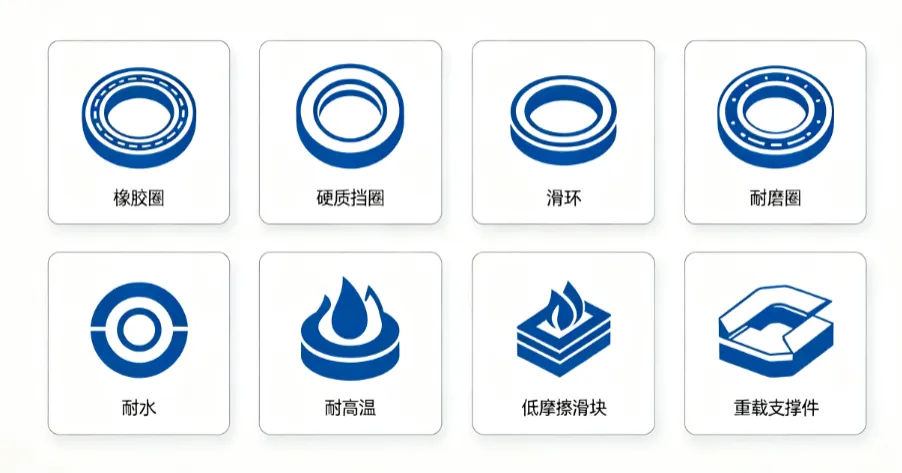
3、 Key points for installing various types of seals: standardized operation to prevent 80% of failures
Core principles for sealing installation: no scratches, no distortion, no reverse installation, and no compression. The installation focus of different types of seals varies, and standardized assembly can significantly extend their service life.
1. Key points for installing shaft seals
The sealing lip must face towards the inside of the oil cylinder (the side with pressure and oil), as reverse installation will directly cause oil leakage and failure; The end of the piston rod must be chamfered and deburred to remove sharp corners; When passing through sharp positions such as threads and keyways, a special protective sleeve must be installed to prevent cutting the sealing lip; After assembly, check that the sealing components are flat and free of distortion. Do not pry them with sharp tools such as screwdrivers.
2. Key points for sealing installation of holes
Align the sealing lip with the pressure chamber of the oil cylinder, and distinguish the direction of force for the bidirectional sealing structure; The inlet of the cylinder must be chamfered, and equipment without chamfers should use an assembly cone sleeve to avoid cutting the seal with sharp edges; The sealing ring made of PTFE material should avoid small holes on the piston to prevent damage from high-pressure compression; During assembly, only the metal parts of the piston can be struck, and it is strictly prohibited to directly strike the sealing components.
3. Key points for installing dust seals
The direction cannot be reversed: the dust lip faces outward (in contact with air), and the inner sealing lip faces the oil cylinder; The lip of the dust ring is extremely thin and prone to damage, so protective measures should be taken throughout the assembly process; The dust ring with a snap spring must ensure that the snap spring is fully inserted into the slot to avoid being carried out by the piston rod during operation; Do not apply too much lubricating grease, otherwise it is easy to adhere mud and accelerate wear.
4. Key points for installation of guide ring
The open-ended guide ring cannot be docked and stuck, and a gap should be reserved to prevent the equipment from getting stuck due to thermal expansion; The winding guide belt joint cannot overlap, it can naturally fit the groove; When multiple guide rings are used in combination, the opening positions should be staggered to avoid force concentration; The corners of the groove must be polished smooth to prevent sharp edges from cutting and damaging the guide ring.
5. Key points for static seal installation
Control the degree of compression of the O-ring. Pressing it too tightly can cause permanent deformation and aging, while pressing it too loosely can lead to poor sealing and leakage; During installation, avoid twisting and twisting Fried Dough Twists of O-ring. The installation groove must be cleaned of iron filings and impurities; When installing flanges and end caps, the bolts should be tightened diagonally in multiple times, and should not be locked on one side at a time to prevent uneven stress, oil leakage, and air leakage; Gaskets and O-rings for high temperature and high pressure conditions should be replaced directly after disassembly and should not be reused.
6. Key points for installing rotary oil seals
The lip of the oil seal with a spring faces towards the oil chamber, and check if the spring is intact and not detached; Only press the metal part of the outer ring of the oil seal, and never tap or squeeze the lip; The threads and keyways on the shaft must be fitted with protective sleeves to prevent scratching the lips; After installation, apply a thin layer of suitable lubricating oil to the lip, do not fill it with grease, and avoid rotating and heating to damage the oil seal; Ensure that the oil seal is installed smoothly, without tilting, and flush with the equipment end face.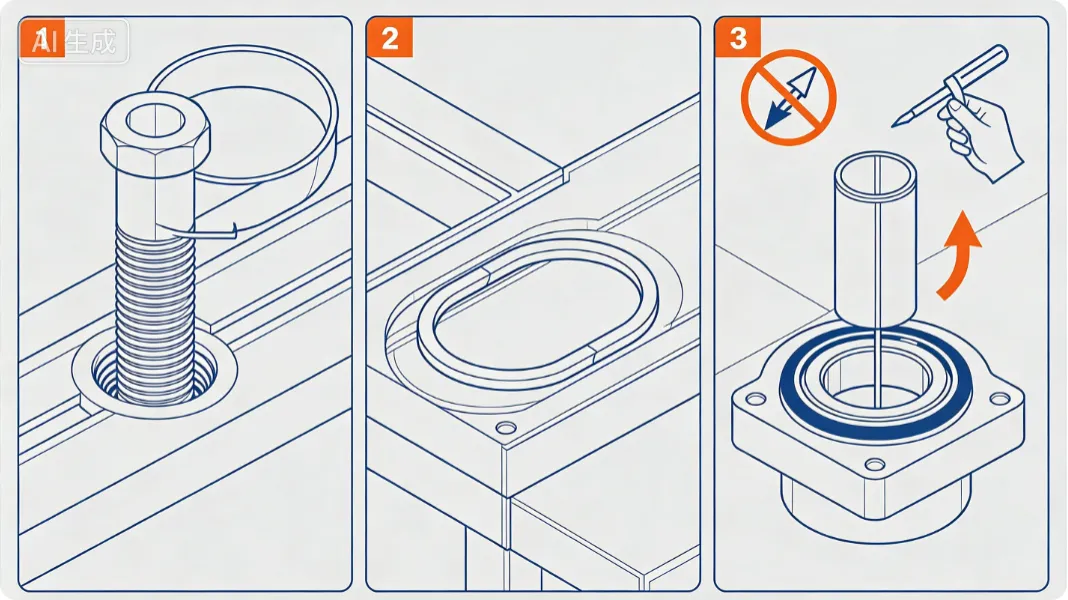
4、 Material installation taboos+general installation guidelines
1. Exclusive installation taboos for different materials
Polyurethane seals have high hardness and should not be pried with sharp tools or baked at high temperatures to prevent permanent deformation; EPDM rubber must not come into contact with engine oil or hydraulic oil to avoid swelling and failure; Fluororubber has low elasticity, so do not over stretch it during installation to prevent cracking; PTFE seals should not be forcefully twisted or stretched, and can be assembled with warm water assistance. Open flame heating is strictly prohibited; Silicone and fluorosilicone materials are fragile in texture, and the entire assembly process should avoid bumps and scratches.
2. All seals are installed with universal iron rules
Only use soft tools such as plastic, copper, and aluminum for assembly, and prohibit sharp steel tools from directly contacting the sealing components; All threads, sharp edges, and steps of the equipment must be properly protected; Thoroughly clean the grooves, shafts, and holes before assembly to ensure no impurities or burrs; Only use equipment compatible lubricating oil for lubrication, and do not use gasoline or diluents to clean rubber seals; The disassembled seals should not be reused in principle; After assembly is completed, manually test run without any jamming or abnormal noise, and then apply pressure for operation.
5、 Quick selection summary (practical mnemonic)
Normal hydraulic equipment at room temperature: select nitrile rubber and polyurethane; Hot water, steam, and water purification equipment: choose EPDM rubber; High temperature and chemical corrosion conditions: choose fluororubber; High pressure, high-speed and precision equipment: choose PTFE combination seal; Anti oil leakage of rotating shaft: select skeleton oil seals that are suitable for the working conditions; All high-pressure working conditions must be equipped with nylon and PTFE retaining rings.
Choosing the right material and installing it in a standardized manner is the core key to avoiding sealing leaks, extending equipment life, and reducing downtime caused by malfunctions.