
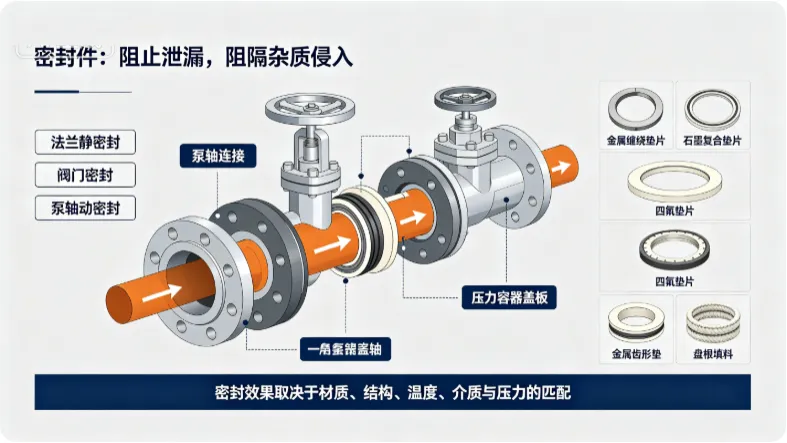
Seals are the core basic components of industrial equipment, pipelines, valves, and pressure vessels. Their core function is to block fluid medium leaks and prevent external dust, impurities, and water vapor from entering the interior of the equipment, ensuring the stable and safe operation of the entire mechanical system. The effectiveness of industrial seals depends on the performance of the sealing material, temperature adaptability, medium tolerance, mechanical strength, aging resistance and other parameters, which directly determine the service life and adaptability to working conditions of the seals.
At present, the commonly used sealing materials in the industrial field are mainly divided into four categories: rubber elastic materials, polytetrafluoroethylene materials, flexible graphite and woven packing materials, and metal hard sealing materials. There are significant differences in the performance of various materials, and they are suitable for different temperature, pressure, and medium working conditions. This article will objectively and detailedly introduce the basic parameters, performance characteristics, advantages and disadvantages, and applicable scope of various sealing materials based on industrial practical application scenarios, providing a real and reliable reference for industrial sealing selection.
1、 Rubber sealing material (main elastic sealing material)
Rubber material is the most commonly used elastic sealing material in industry, with good flexibility and compression resilience, suitable for low pressure, room temperature, and conventional working conditions. It is widely used in products such as O-rings, oil seals, rubber gaskets, and soft seals, and is widely used in hydraulic, pneumatic, water treatment, and general machinery fields.
1. Nitrile rubber (NBR)
Nitrile rubber is the most cost-effective universal sealing material and the mainstream choice for oil conditions. The conventional temperature tolerance range is -30 ℃ to 120 ℃, and the short-term extreme temperature tolerance can reach 135 ℃. Aging, hardening, and cracking problems are prone to occur in long-term high-temperature environments.
In terms of medium adaptability, this material has good tolerance to oil media such as mineral oil, hydraulic oil, lubricating oil, gasoline, and grease, and can also adapt to water and air media. But it is not resistant to ketones, esters, organic solvents, strong oxidants, and aromatic media, and cannot adapt to high-temperature steam conditions.
Its core advantages are good mechanical wear resistance, good air tightness, low price, easy processing and molding, and extremely strong comprehensive practicality; Shortboard has poor weather resistance and ozone resistance, and is prone to aging and failure due to long-term outdoor exposure. Mainly used for ordinary hydraulic system O-rings, equipment oil seals, oil circuit sealing gaskets, general mechanical seals, and other normal temperature, low oil, and conventional working conditions.
2. Fluororubber (FKM)
Fluororubber is a special rubber with excellent high temperature and oil resistance. Its conventional temperature resistance range is -20 ℃ to 200 ℃, and some improved grades can withstand high temperatures of up to 250 ℃ for a short time. It is the core sealing material for high-temperature oiling conditions.
The medium has a wide range of adaptability, can stably withstand all kinds of fuel oil, engine oil, high-temperature lubricating oil, oil gas and most weak acid media, has outstanding anti-aging, ozone resistance, high-temperature oxidation resistance, small compression permanent deformation, and excellent sealing stability. The weakness lies in the lack of resistance to polar solvents such as ketones, low molecular weight esters, and ammonia water, as well as high material costs and average low-temperature elasticity.
This material is commonly used in harsh working conditions, including high-temperature oil circuit equipment, engine seals, chemical valves, and elastic seals for high-temperature industrial equipment. It is suitable for the high-end sealing needs of high temperature, oil resistance, and corrosion resistance.
3. Ethylene propylene diene monomer (EPDM) rubber
EPDM rubber is a specialized rubber material for water vapor and steam working conditions, with a temperature resistance range of -40 ℃ to 150 ℃, and can withstand high temperatures of 170 ℃ for a short period of time. It has excellent low-temperature toughness and strong environmental adaptability.
Its core characteristics are water resistance, hot water resistance, saturated steam resistance, weak acid and alkali resistance, and antifreeze medium. It has excellent anti-aging, ozone resistance, and ultraviolet resistance, and is very suitable for outdoor and water treatment conditions. The fatal weakness is that it is completely intolerant to mineral oil, gasoline, and hydrocarbon media, and will quickly swell, deform, and fail when in contact with oil.
Mainly used for sealing hot water pipelines, water treatment equipment, central air conditioning systems, low-pressure steam equipment, and outdoor general equipment, it is the mainstream sealing material in the fields of civil and industrial water treatment.
4. Silicone rubber (VMQ)
Silicone rubber has the core advantages of extreme high and low temperature adaptability and hygiene, with a temperature resistance range of -60 ℃ to 230 ℃. Some specially designed products can withstand high temperatures of 250 ℃ for a short time without hardening or cracking at low temperatures.
The material has good chemical stability, is resistant to air, ozone, and weak acid media, and is non-toxic, odorless, and free of precipitation, with a high level of hygiene. However, it has low mechanical strength, poor wear resistance, and is not resistant to oil and hydrocarbon solvents, making it unsuitable for working conditions with frequent friction and oily media.
Mainly used for sealing food processing equipment, medical equipment, high-temperature drying equipment, and household appliances, it focuses on clean, high and low temperature air sealing scenarios and is not suitable for industrial heavy-duty and wear-resistant working conditions.
5. chloroprene rubber (CR)
Chloroprene rubber is a rubber material with moderate universality, with a temperature resistance range of -35 ℃ to 110 ℃ and balanced comprehensive performance. Good water resistance, weather resistance, ozone resistance, flame retardancy, with mild oil resistance, and moderate price. Shortboard has limited high temperature resistance and is prone to aging and failure under high temperature conditions. Mainly used for outdoor dust-proof sealing, ordinary water pipes, and sealing scenarios for lightweight general equipment.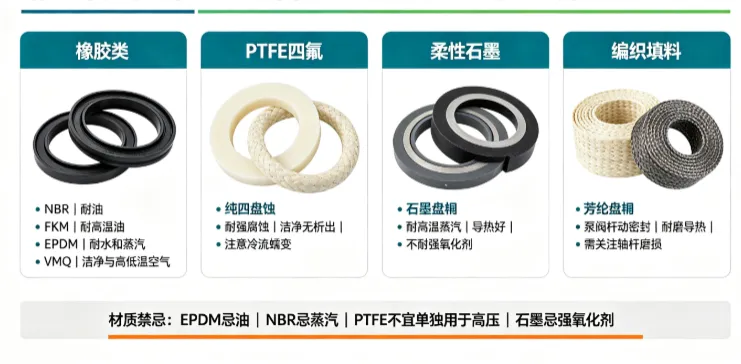
2、 Polytetrafluoroethylene material (PTFE, PTFE)
Polytetrafluoroethylene is the non-metallic sealing material with the best corrosion resistance in industry, known as the "plastic king". Its forms include pure PTFE gaskets, expanded PTFE, PTFE packing, PTFE coated gaskets, etc. It is suitable for strong corrosion and clean working conditions. Its temperature resistance range is -200 ℃ to 260 ℃. Material decomposition may occur above 260 ℃, making it unsuitable for long-term use.
This material has extremely strong chemical inertness and can withstand almost all strong corrosive media such as acids, bases, salts, and organic solvents. Only molten alkali metals and high-temperature fluorine gas can corrode it. At the same time, the material surface is non stick, free of precipitation, and has high cleanliness, which will not contaminate the medium and is suitable for high-purity production scenarios.
The objective shortcomings are very obvious: the material has high hardness, extremely poor elasticity, weak rebound performance, and obvious cold flow creep characteristics. Long term compression will cause permanent deformation. It is easy to leak when used alone under high pressure conditions and is not suitable for high pressure and high-frequency fluctuation conditions. Expanded polytetrafluoroethylene (ePTFE) is an improved version with better flexibility, which can adapt to uneven flange faces and has stronger sealing adaptability.
PTFE material is widely used for flange sealing in highly corrosive chemical pipelines, pharmaceuticals, food, and high-purity electronic media equipment. Its PTFE packing can be used for dynamic sealing of pump shafts and valve stems under corrosion-resistant conditions, and is the core material for anti-corrosion sealing.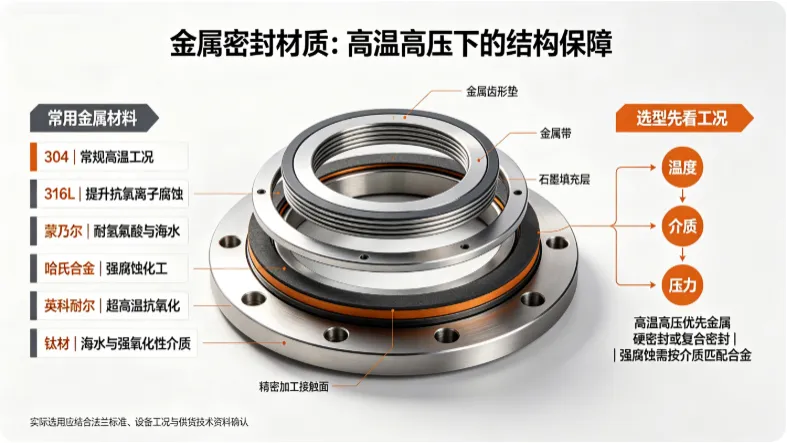
3、 Flexible graphite and woven packing material (high-temperature universal seal)
This type of material mainly includes flexible graphite and various woven packing materials, which are mainstream sealing materials for high temperature, steam, and medium high pressure conditions. They are mostly used for static sealing gaskets and dynamic sealing fillers, and are suitable for traditional industrial scenarios such as petrochemicals, electricity, and boilers.
1. Flexible graphite (expanded graphite)
Flexible graphite has excellent high temperature resistance, with a temperature resistance of over 650 ℃ in anaerobic environments. In conventional aerobic oxidation environments, the upper limit of safe temperature resistance is 450 ℃, and the lower limit of temperature resistance range can reach -200 ℃. The material is suitable for steam, hot oil, most oils, weak acid and alkali media, with good thermal conductivity, strong compressibility, excellent rebound performance, and high sealing adhesion.
The material has clear usage limitations: it is not resistant to strong oxidizing agents such as concentrated nitric acid and concentrated sulfuric acid, and will quickly corrode and fail upon contact; At the same time, the material is brittle and prone to powdering, and oxidation loss may occur in long-term high-temperature aerobic environments, requiring regular inspection and replacement.
In industry, it is commonly used as a filling material for metal wound gaskets, a core material for graphite composite gaskets, and can also be made into graphite packing. It is widely used for sealing boilers, high-temperature steam pipelines, petrochemical flanges, and heat exchange equipment, and is a universal preferred material for high-temperature and medium pressure working conditions.
2. Aramid packing
Aramid (Kevlar) is a high-strength woven filler material with a temperature resistance range of -100 ℃ to 280 ℃, suitable for oils, solvents, and weak acid and alkali media. The core advantages are high mechanical strength, wear resistance, and resistance to compression. It can adapt to high-speed friction conditions of pump shafts and valve stems, and its compressive performance far exceeds that of ordinary packing.
Shortboard is not resistant to strong acid and alkali corrosion, and is prone to heat and wear under dry friction. In industrial use, it is often mixed with graphite and PTFE to compensate for single material defects. Mainly used as dynamic sealing packing for high-pressure water pumps, chemical mixers, and industrial valve stems.
3. Carbon fiber packing
Carbon fiber disc root has a temperature resistance range of -200 ℃ to 350 ℃, suitable for oil, water, weak acid and alkali media, excellent thermal conductivity and self-lubricating properties, wear and high temperature resistance, and is not easily heated or burned during friction, with strong sealing stability. The disadvantage is that the material hardness is relatively high, and long-term use will cause slight wear on the equipment shaft body, and the procurement cost is high. It is mostly used for packing sealing in high-temperature oil pumps and high-pressure industrial valves.
4、 Metal sealing material (special for high temperature, high pressure and harsh working conditions)
Metal sealing material belongs to the category of hard sealing materials, with high mechanical strength, high temperature resistance, high pressure resistance, and no hidden dangers of aging and deformation. It is specifically suitable for special equipment, high-pressure pipelines, and high-temperature and high-pressure reaction equipment, and is the core sealing material for high-end and harsh working conditions. It is mainly made into products such as metal wrapped gaskets, toothed gaskets, and metal ring gaskets.
1. Low carbon steel/soft iron
The upper temperature limit is 450 ℃, suitable for non corrosive media such as steam and oil, with good plasticity, easy processing, and low cost. The disadvantage is that it is prone to rust and has poor corrosion resistance. It is only suitable for sealing conventional low-pressure, non corrosive industrial equipment and is mostly used for processing ordinary metal gaskets.
2. 304/316L stainless steel
Both stainless steel materials have a temperature resistance range of -200 ℃ to 800 ℃, high temperature resistance, high mechanical strength, and are not easily deformed. 304 stainless steel is suitable for atmospheric, freshwater, weak acid and other conventional chlorine free corrosion conditions; 316L stainless steel has improved its resistance to chloride ion corrosion on the basis of 304, with better resistance to weak corrosion. It is a commonly used metal sealing material in the petrochemical industry and is often used as a metal sealing gasket for conventional chemical and power equipment. The common weakness of both is the inability to withstand strong corrosive media such as strong acids and chloride ions.
3. Special alloy materials
Monel, Hastelloy, Inconel, and titanium are high-end special sealing alloys that specifically solve extreme working conditions of high temperature and strong corrosion coexistence. Their prices are much higher than ordinary stainless steel.
Monel (copper nickel alloy) has a maximum temperature resistance of 450 ℃ and is resistant to corrosion from seawater, alkaline solution, hydrofluoric acid, and chloride ions. It is suitable for sealing marine equipment and salt alkali working conditions; Hastelloy (C276/B2) has a temperature resistance of up to 600 ℃ and can withstand extreme corrosive media such as wet chlorine gas and strong oxidizing acids. It is a specialized material for highly corrosive chemical conditions; Yingke Nair alloy has the best high temperature resistance, and can adapt to temperatures up to 1000 ℃. It has strong resistance to high-temperature oxidation and is commonly used in high-temperature furnaces and ultra-high temperature oil and gas equipment; Titanium material has a temperature resistance of ≤ 500 ℃, is resistant to seawater, chloride ions, and strong oxidizing acid corrosion, and is suitable for harsh anti-corrosion scenarios in marine and fine chemical industries.
5、 General non-metallic sheet material
Non asbestos fiber gasket is an environmentally friendly alternative to traditional asbestos gasket, with a temperature resistance limit of 250 ℃. It can adapt to medium and low pressure conventional working conditions such as water, steam, and oil, and has high cost-effectiveness and wide applicability. It is a universal sealing material for ordinary pipeline flanges. The disadvantage is limited corrosion resistance and temperature and pressure resistance, making it unsuitable for high temperature, high pressure, and strong corrosion conditions.
Asbestos material has been explicitly restricted from use in the domestic industrial sector due to its carcinogenic risk. Only existing old equipment can be seen, and the use of new or renovated industrial equipment is prohibited.
6、 Core principles for selecting industrial sealing materials
1. Working condition priority principle: Temperature, medium, and pressure are the three core elements for selection, among which the corrosiveness of the medium and long-term use temperature have the greatest impact on the service life of the sealing material. For high-pressure working conditions, metal hard seals or composite sealing materials are preferred.
2. Avoid material taboos: Strictly avoid materials that are not compatible with the medium, such as EPDM avoiding oil, NBR avoiding steam, PTFE avoiding high-pressure use alone, graphite avoiding strong oxidants, etc., to prevent seal failure from the source.
3. Precise scene matching: For flange static sealing, graphite composite gaskets, metal winding gaskets, PTFE gaskets, and metal hard sealing gaskets are preferred; Priority should be given to using various types of braided gaskets and rubber elastic seals for the dynamic sealing of pump valve rods; Prioritize food grade PTFE and silicone rubber for clean working conditions; Select special alloy materials for harsh high-temperature corrosion conditions.
4. Balancing practicality and economy: High cost-effective materials such as universal rubber and asbestos free boards are selected for conventional working conditions; Select special materials as needed for harsh working conditions, do not blindly upgrade materials, and do not choose low-priced materials that lead to frequent leaks and replacements.