Seals are the basic components of mechanical equipment, mainly used to prevent fluid medium leakage and block external dust and impurities from entering the interior of the equipment. According to whether there is relative motion between the sealing mating surfaces, sealing is divided intoStatic seal与Dynamic sealTwo major categories. There is no relative motion between the two parts of the static seal, and the micro gap is filled by the elastic pre tightening force generated by assembly compression, making it easy to achieve zero leakage; The two mating surfaces of the dynamic seal undergo reciprocating sliding or rotating motion, and are widely used in pump shafts, hydraulic cylinder piston rods, and other parts. The working conditions are more complex and prone to various failures, making it a key focus of equipment seal maintenance.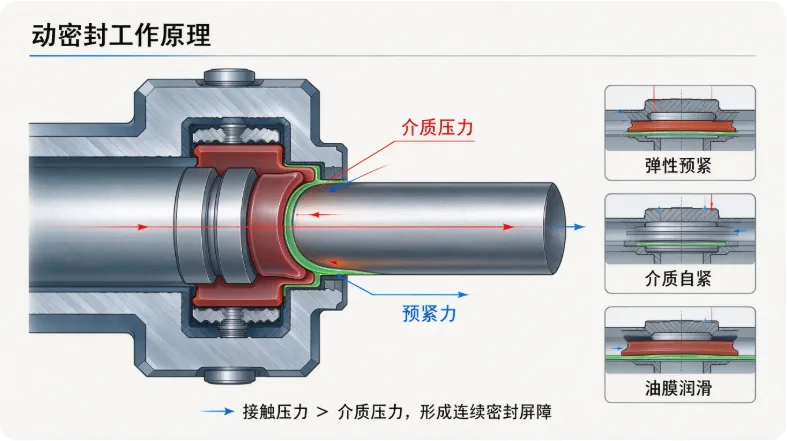
Dynamic seals are divided into contact dynamic seals and non-contact dynamic seals. Contact type dynamic seals include oil seals, Y-rings, Glay rings, Steller seals, etc. The sealing principle relies on the elasticity of the sealing element itself to generate initial preload force, so that the lip or slip ring is tightly attached to the sliding surface, filling the metal surface with small bumps and depressions; When the pressure of the medium increases, the medium pressure will further press the tight seal, producing a self sealing effect. The sliding surface will form a micrometer sized thin oil film, which not only serves to lubricate and reduce wear, but also blocks the medium leakage channel. Non contact dynamic seals mainly use labyrinth seals and gap seals, relying on the principle of multi-stage throttling and pressure reduction to reduce fluid pressure, without friction and wear, but cannot achieve zero leakage.
During the long-term operation of equipment, dynamic seals may experience various malfunctions due to factors such as installation, medium, temperature, pressure, and surface quality. Common faults include leakage upon installation, slow leakage during later use, seal extrusion damage under high pressure, seal swelling and hardening, rapid wear due to frictional heating, and secondary damage caused by dust ring failure.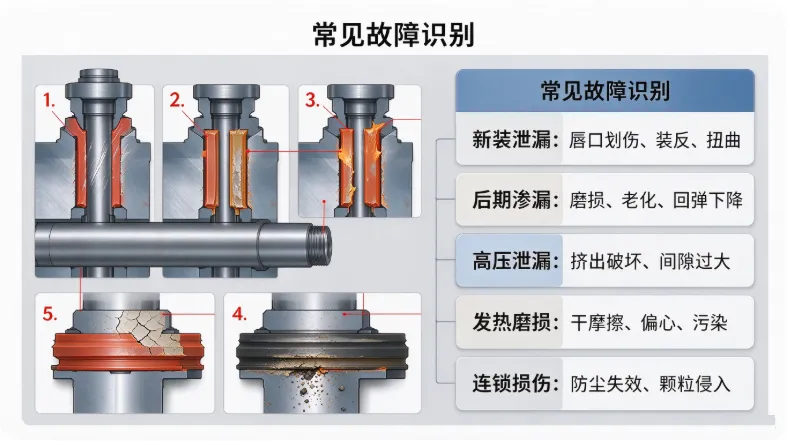
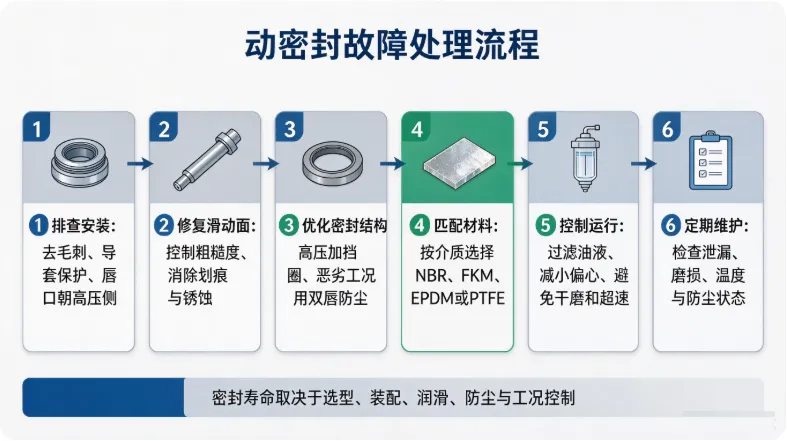
Leakage immediately after installation is mostly caused by improper installation. There are burrs and scratches on the sealing lip at the shaft end and hole opening, the sealing lip direction is reversed, the sealing component is twisted, or the sealing specification selection is incorrect. Corresponding solution: Clean the burrs on metal parts before assembly and use assembly guides to protect the seals; Ensure that the sealing lip faces the high-pressure side during installation; Select sealing components that match the specifications, apply medium lubrication during assembly to avoid lip scratches.
After running for a period of time, the equipment slowly leaks, usually due to lip wear, piston rod or shaft surface scratches, aging of sealing materials, permanent compression deformation, and decreased elasticity. Solution: Repair scratches and rust on the surface of the sliding shaft; Replace with new sealing components; Install or maintain dust seals to prevent dust from entering the friction pair; Control the working temperature and slow down the aging rate of the seal.
Leakage occurs under high pressure conditions, and the edge of the seal is bitten off, which belongs to extrusion damage. High pressure media can squeeze the sealing material into the metal fitting gap, causing damage. Solution: Install PTFE retaining rings under high-pressure conditions; Reduce the gap between metal fittings; Choose high-pressure sealing structures such as Glay rings and Steller seals, and do not use ordinary O-rings alone to withstand high-pressure reciprocating motion.
The root cause of swelling, hardening, and cracking of the seal is the mismatch between the sealing material and the working medium. For example, EPDM rubber will swell when in contact with mineral oil. Solution: Re select according to the medium, choose nitrile rubber or fluororubber for mineral oil; Use EPDM rubber for water and weak acid media; The strong corrosive medium adopts polytetrafluoroethylene composite sealing.
Heating and rapid wear during sealing work are often caused by dry friction, shaft eccentricity, excessive radial runout, medium contamination, and linear velocity exceeding the allowable range of the seal. Solution: Ensure that the sliding surface maintains a lubricating oil film and strictly prohibit dry friction operation; Correct the shaft components to reduce eccentricity and runout; Filter media to remove solid particles from the oil; Select a sealing structure that meets the requirements of the operating line speed to improve the heat dissipation conditions.
The dust seal is damaged and ineffective, and dust and sediment are carried into the interior of the equipment with the piston rod, which can scratch the piston rod and main seal, causing chain damage. Solution: Replace the dust ring in a timely manner; Double lip dust-proof structure is selected for working conditions with severe dust. O-rings used for reciprocating motion are also prone to twisting, cutting, and tearing. Therefore, the compression capacity of the O-ring dynamic seal should be reduced, or Y-shaped rings or Glay rings should be used instead.
In summary, dynamic seal failure is not caused by a single factor, installation quality, material selection, operating parameters, and dust protection can all affect the seal life. Proper selection, standardized assembly, regular maintenance, and control of medium pollution can effectively reduce the probability of dynamic seal leakage and extend the service life of seals and equipment.